
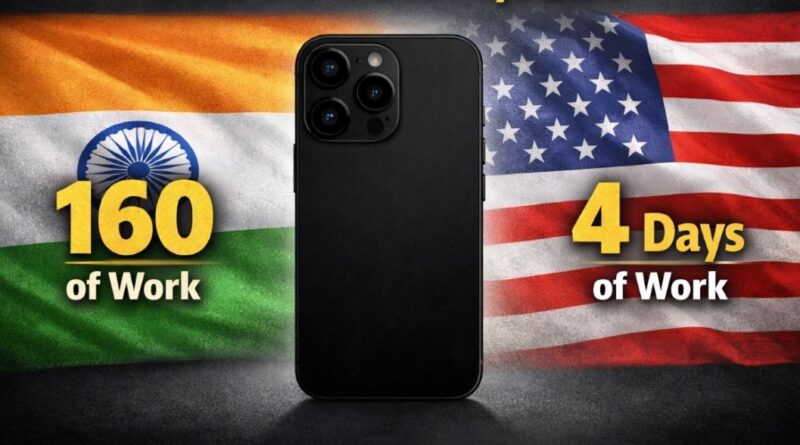
Why Indian Youth Buy iPhones on EMI (While the US, UK & China Pay Cash)
Let’s stop pretending.
An American buys an iPhone in less than a week.
An Indian buys the same iPhone after almost 6 months of work.
Same phone.
Very different reality.
This is not about loving technology.
This is about income vs price, and most people don’t want to talk about it honestly.
First, the Basic Math (No Emotion)
The Apple iPhone 17 Pro costs:
$1,099 in the USA
₹1,34,900 in India (around $1,620 after taxes)
Apple sells the phone at a global level.
Your salary, unfortunately, is local.
Here’s the comparison that actually matters.
Average Income vs iPhone 17 Pro Cost
| Country | Avg Net Daily Income | iPhone 17 Pro Price | Days of Work Needed |
|---|---|---|---|
| 🇺🇸 USA | ~$260/day | ~$1,099 | 4–5 days |
| 🇬🇧 UK | ~$125/day | ~$1,099 | 7–9 days |
| 🇨🇳 China | ~$95/day | ~$1,250 | 25–27 days |
| 🇮🇳 India | ~$11/day | ~$1,620 (₹1.35L) | 150–160 days |
Read the India row again. Slowly. Believe it or not, I have increased our daily income to over 200-250 INR.
An average Indian works 30 – 40 times longer than an American to buy the same phone.
That’s not obsession.
That’s economics.
Why People in the US Buy iPhones Without Thinking
In the US:
iPhone = one week’s income
No serious dent in savings
Paid via cash or card
EMI is convenience, not necessity
Buying an iPhone there is like buying a decent appliance.
Expensive, yes. Life-changing? No.
Why Indians Almost Always Choose EMI
In India:
iPhone = half-year income
Paying full cash hurts badly
EMI spreads the damage
Decision feels easier
That’s the whole story.
EMI doesn’t make the phone cheaper.
It just hides the pain.
Aur yahin se problem shuru hoti hai.
Let’s Be Honest About EMI
₹1.35 lakh sounds scary.
₹5500 / ₹6000 per month sounds manageable.
That’s psychology, not affordability.
But EMI means:
Money locked for 12 – 24 months
Savings slowed down
Emergency fund compromised
Financial flexibility gone
You don’t feel it on day one.
You feel it month after month.
The Part People Get Angry About (But It’s True)
For most people, once a phone crosses a certain price:
Daily life does not change.
Calls? Same
WhatsApp? Same
Payments? Same
Social media? Same
A ₹25000 phone and a ₹1.35 lakh phone do the same daily kaam.
What you pay extra for is:
Brand
Status
Social validation
That’s fine – if you can afford it.
When Buying an iPhone Actually Makes Sense
Here’s where nuance matters.
If buying an iPhone helps you earn money, it’s not a luxury – it’s a tool.
Examples:
Photographer using iPhone camera professionally
YouTuber shooting, editing, uploading daily
Content creator making reels, shorts, brand deals
Instagram pe nachane wale earning from reach (Sorry – but I hate your success guys, wish I had that much willpower)
Business owner using ecosystem for work efficiency
In these cases:
Phone = income-generating asset
Cost can be recovered
EMI may even make sense
If the phone pays you back, buy it without guilt.
When It Does NOT Make Sense
If you’re buying an iPhone mainly for:
Social pressure
Comparison with friends
“Sabke paas hai”
Feeling premium
Then be honest with yourself.
A phone that costs 160 days of work and earns you ₹0 is not a smart buy.
It’s an emotional decision pretending to be a rational one.
One Simple Rule (Works Every Time)
Before buying a premium phone, ask:
Can I buy this without financial stress?
Will this help me earn or grow?
Will I care after 6 months?
Am I buying utility or validation?
If answers feel shaky, stop.
Paise banana mushkil hai.
Phone lena aasaan.
No Sugarcoating
Americans buy iPhones in days.
Indians buy iPhones in months.
Not because Indians are careless.
But because incomes are lower and prices are global.
There’s nothing wrong with liking good technology.
But using EMI to stretch your future income for a phone that mostly gives status?
That deserves serious thought.
End of the day – kaam ka phone lo, sirf show-off ka nahi.